I am a Ph.D. student in the Department of Statistics at Purdue University,
co-advised by Dr. Qifan Song (Purdue University) and
Dr. Murat Kocaoglu (Johns Hopkins University), and a member of the
CausalML Lab. Before my Ph.D., I received an M.S. in Applied Statistics
from Purdue University and a B.S. in Applied Statistics from Shanghai University of Finance and Economics.
My research develops causal discovery methods for time series: learning causal relations
from observational data when samples are temporally dependent and the underlying mechanisms may be stationary,
periodic, or subject to abrupt change. Recently, I have also been studying how transformers perform causal
in-context learning from heterogeneous interventional data.
Research interests: causal discovery in time series · causal in-context learning ·
change point detection · conditional independence testing
Published Papers
AISTATS 2026
Stationarity-Aware Causal Discovery in Time Series via Minimal Separating Sets
Shanyun Gao, Raghavendra Addanki, Tong Yu, Ryan A. Rossi, Qifan Song, Murat Kocaoglu
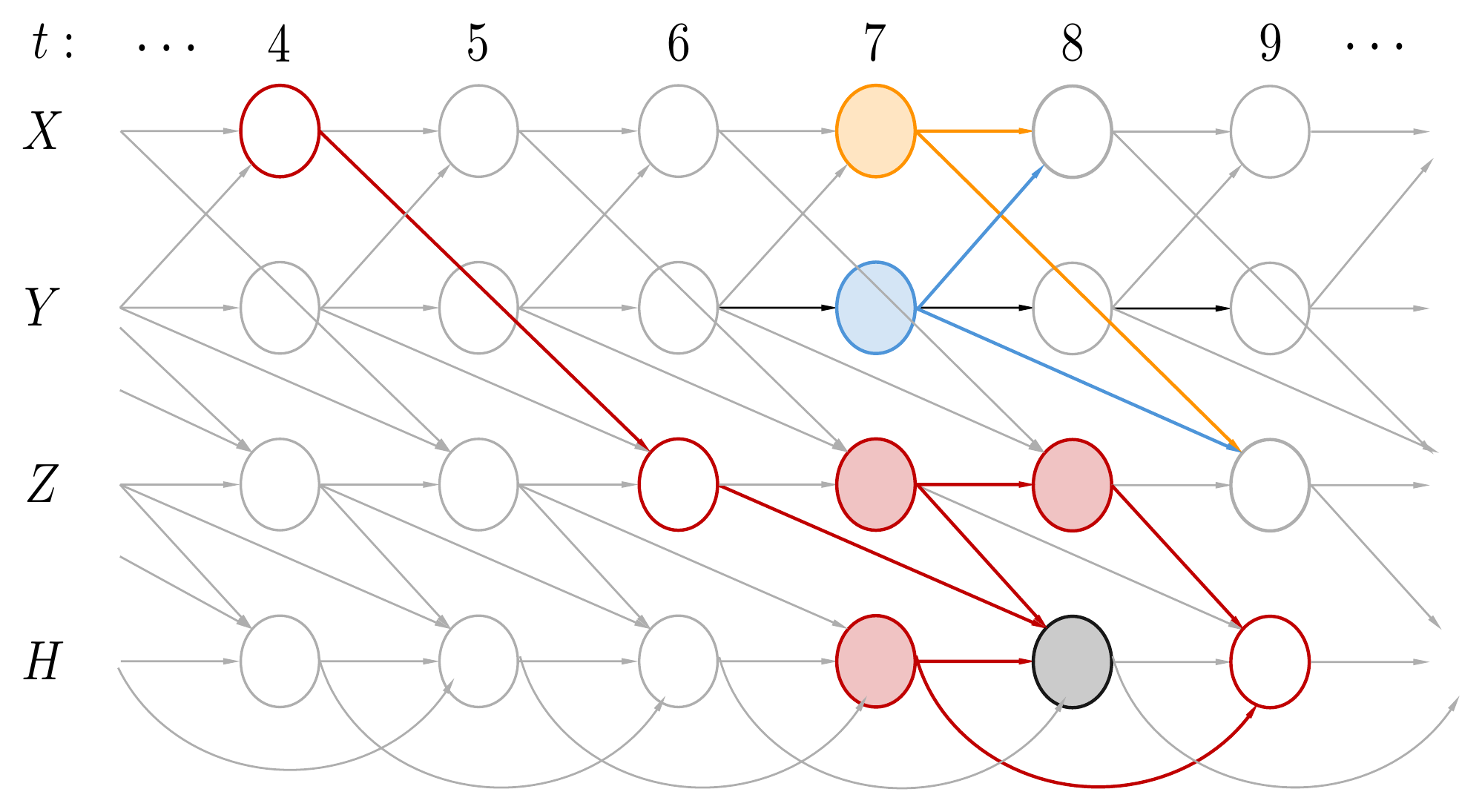
Under causal stationarity, the separating sets between lagged variables are far from arbitrary: the repeated graph and the lag-1 self-autoregressive edges force them into a predictable shape. We characterize this shape through Lag-Anchored Separating Sets (LASS), minimal separating sets that are guaranteed to contain a variable's parents, and build MSSD, a two-stage constraint-based algorithm that uses them to guide the search itself rather than only to orient edges. In the figure, \(\{X_7, Y_7\}\) (orange/blue) is the unique minimal separating set between \(X_8\) and \(Z_9\), while the red path between \(X_4\) and \(H_9\) shows how a lag-anchored separating set is formed. MSSD achieves the highest F1 and lowest SHD across synthetic benchmarks and a real river-flow dataset.
@inproceedings{gao2026stationarity,
  title     = {Stationarity-Aware Causal Discovery in Time Series via Minimal Separating Sets},
  author    = {Gao, Shanyun and Addanki, Raghavendra and Yu, Tong and Rossi, Ryan A. and Song, Qifan and Kocaoglu, Murat},
  booktitle = {Proceedings of the 29th International Conference on Artificial Intelligence and Statistics},
  series    = {Proceedings of Machine Learning Research},
  volume    = {300},
  year      = {2026}
}
AISTATS 2025
Causal Discovery-Driven Change Point Detection in Time Series
Shanyun Gao, Raghavendra Addanki, Tong Yu, Ryan A. Rossi, Murat Kocaoglu
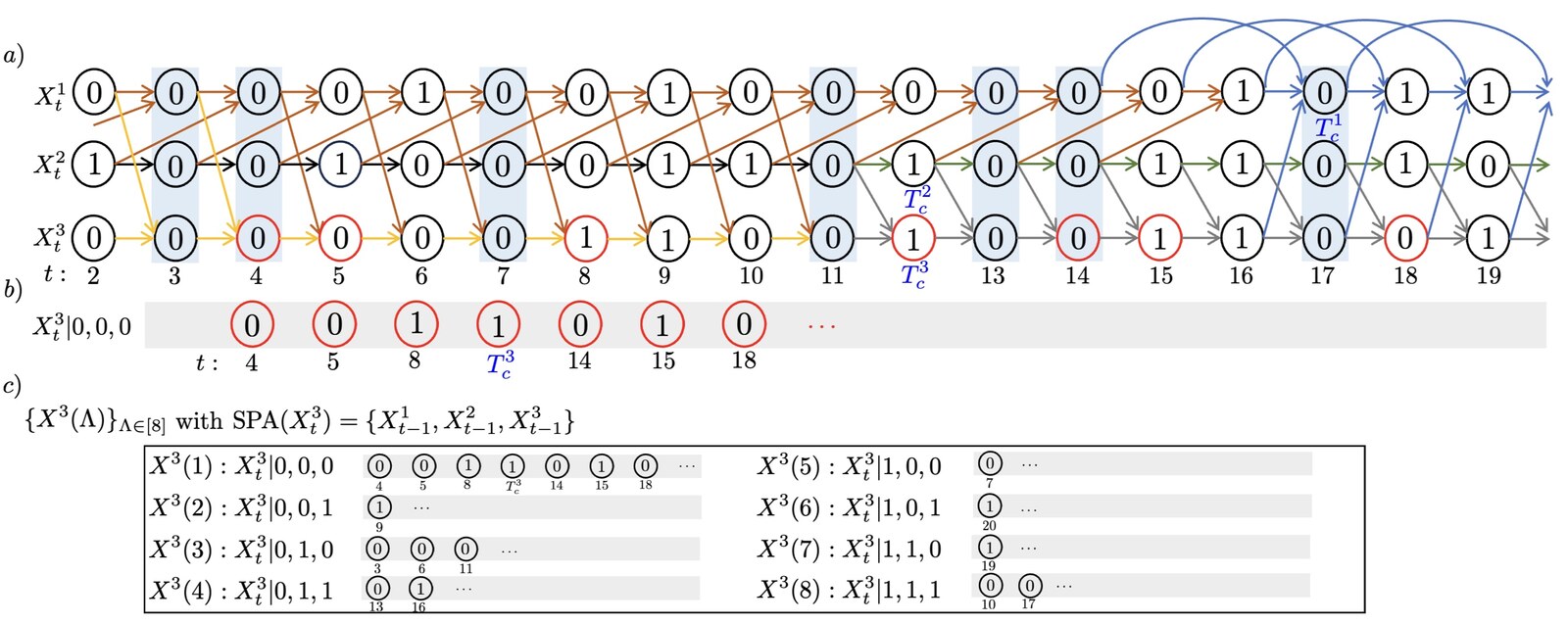
Classical change point detection flags any shift in the joint distribution of a multivariate series. Often we care about something narrower: when did the causal mechanism generating one particular variable change? Causal-RuLSIF answers this in two stages. It first learns each variable's parents with constraint-based causal discovery, then groups the observations by parent configuration (panels b–c), which yields i.i.d. segments by the Causal Markov Condition, and scans them with a conditional relative Pearson divergence to locate the change. Panel (a) shows a mechanism-shift SCM in which each variable \(X^j\) has its own change point \(T_c^j\).
@inproceedings{gao2025causal,
  title     = {Causal Discovery-Driven Change Point Detection in Time Series},
  author    = {Gao, Shanyun and Addanki, Raghavendra and Yu, Tong and Rossi, Ryan A. and Kocaoglu, Murat},
  booktitle = {Proceedings of the 28th International Conference on Artificial Intelligence and Statistics},
  series    = {Proceedings of Machine Learning Research},
  volume    = {258},
  year      = {2025}
}
NeurIPS 2023
Causal Discovery in Semi-Stationary Time Series
Shanyun Gao, Raghavendra Addanki, Tong Yu, Ryan A. Rossi, Murat Kocaoglu
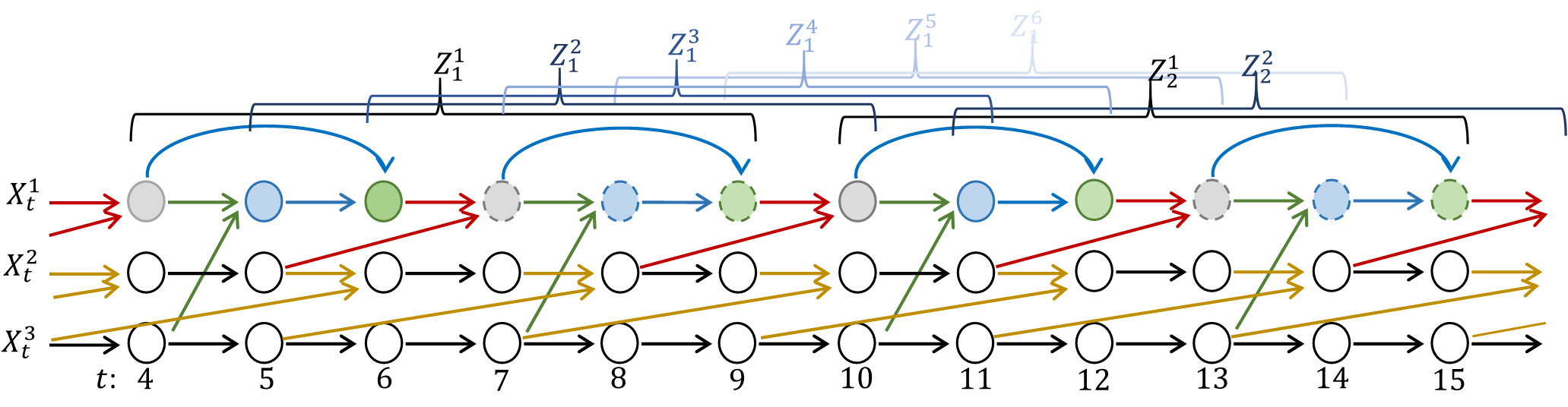
Many real-world series are periodic: traffic follows the commute, electricity use follows day and night. For such data, assuming one stationary causal graph is too strong, while allowing arbitrary change is too weak. We introduce the semi-stationary SCM, in which a finite set of causal mechanisms recurs periodically over time, and propose PCMCIΩ, a nonparametric, constraint-based algorithm that estimates each variable's periodicity and then recovers the periodically alternating causal graph with conditional independence tests. In the figure, \(X^1\) cycles through three mechanisms (red, green, and blue edges) and \(X^2\) alternates between two. The method is provably sound for discrete-valued series and is applied to a real climate dataset.
@inproceedings{gao2023causal,
  title     = {Causal Discovery in Semi-Stationary Time Series},
  author    = {Gao, Shanyun and Addanki, Raghavendra and Yu, Tong and Rossi, Ryan A. and Kocaoglu, Murat},
  booktitle = {Advances in Neural Information Processing Systems},
  volume    = {36},
  pages     = {46624--46657},
  year      = {2023}
}